
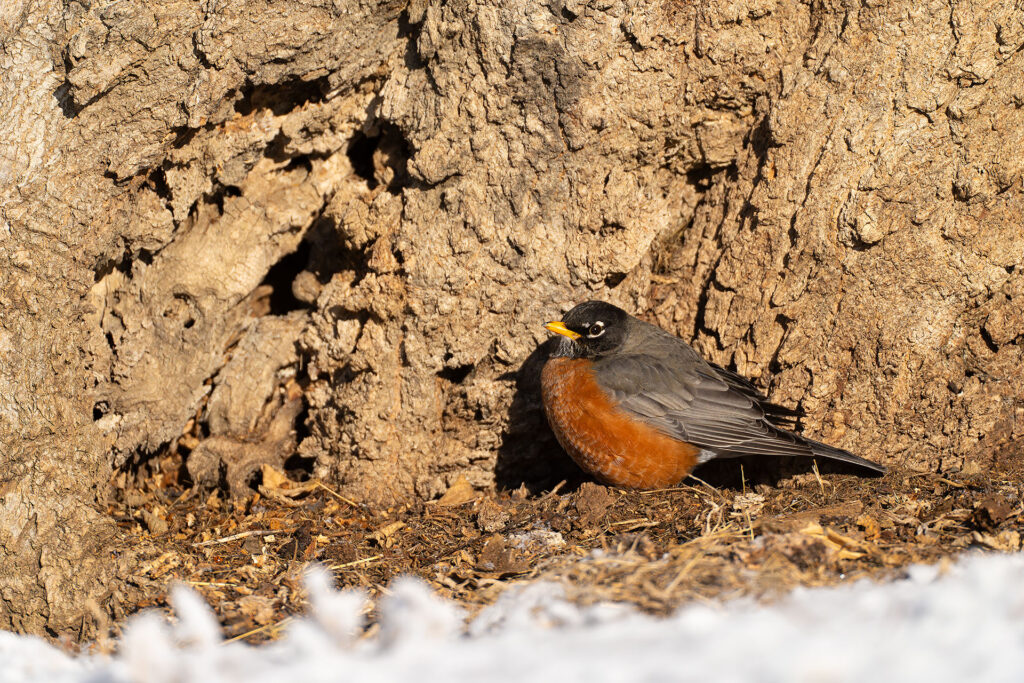
What is a micro-climate and what does it mean for wildlife? Most people have a general knowledge of microclimate but may not have heard this term. For example, you likely have seen flowers emerging sooner on the south side of the house than on the north side. Why? The south side receives direct sunshine, hence more heat warming up the soil sooner. The same principle applies to south-facing vs. north-facing slopes. South-facing slopes warm up sooner in the Spring. A structure, whether that is a building or even a tree, plays a role in creating microclimates. Concrete and brick walls absorb, store, and re-radiate heat, creating tiny microclimates. The south side of a tree trunk acts in the same way. A microclimate can be as small as a few square feet.
Wildlife takes advantage of these small areas for sheltering and feeding. Understanding this can help you find wildlife. March 16th, 2026 was a cold blustery day in Iowa, following a night of high winds and a couple inches of snow. The temperature at sunrise was barely above zero, with a strong northwest wind and a sunny sky. A few of the early migratory birds have already arrived. They can handle the cold because they understand microclimates.

There is one very small area at our local state park where I can count on finding birds after a winter storm. It is on the south side of a large tree, on an open, south-facing slope (warmth from sunlight). To the north of this tree there is a lot of woody vegetation to block the wind. This creates a tiny refuge from the elements. And the birds know it.

Microclimates also affect insect and invertebrate activity. While these areas can be good place for birds to shelter, they can also provide a food resource.

I could have tromped through the woods all morning looking for birds. Instead, I placed myself near the base of that old tree, waiting for the sun to rise and the birds to come to me. Sure enough, they came. The sad part was that I did not get much exercise since I parked my truck only a few feet away from where I laid on the ground. Yet, the birds stayed even when I crawled in my truck, started it, and drove away. They were in a good place. And I had to thaw out my toes.
So beautiful. I love the birds, I do see so many, living by the woods and creek. Thank you for sharing all the beauty you have experienced. Enjoyed the microclimate lesson! I always kept that in mind when planting flowers! Thanks again Stan.
Thanks Sue. Even a city itself is a microclimate due to all of the buildings and concrete that can absorb the heat.
Beautiful birds!!
Thank you Kathleen. It was a fun morning.
Stan, All those robins by the tree is an outstanding photo! Thanks for sharing your talent and nature’s goodness. CJ Niles
Thanks CJ. There were even more Robins in the general vicinity.
So wonderful to see the flock of robins. I just learned the word “piloerection” which I’m sure you know. They’re demonstrating it well, aren’t they? Interesting lesson on microclimate, too – thanks!
Your posts are always a bright spot in my day!
Thank you Carol. I always enjoy seeing your travel posts too.